Reading Marx by Slavoj Zizek Frank Ruda Agon Hamza & Frank Ruda & Agon Hamza
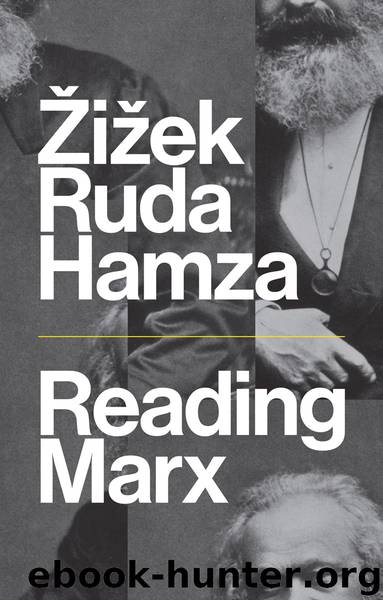
Author:Slavoj Zizek,Frank Ruda,Agon Hamza & Frank Ruda & Agon Hamza
Language: eng
Format: epub
ISBN: 9781509521449
Publisher: John Wiley & Sons, Inc.
Published: 2018-05-12T00:00:00+00:00
The Immanence of Reduction, or: Lacking (Animal) Lack
How does this affect the worker? One should recall that the capitalist organization of production necessarily generates a spatial condensation of the multiplicity of workers into a cooperative collective “single force” in the modern factory system (which in principle remains pertinent even today). This condensation “begets . . . a rivalry and a stimulation of the ‘animal spirits’, which heighten the efficiency of each individual worker”:103 such working conditions allow for a spontaneous ideology of the sole survival of the fittest. Working under capitalist conditions, everyone thereby becomes filled by the “Furies of private interest,”104 being an appendix of a “mechanical monster whose body fills the whole factory”105 of society – a monster of which “the workers are merely conscious organs”106 that are conscious because they know they are executing the interest of someone else for the sake of their own interest. This indicates a structural perversion: the worker becomes the mere instrument of another whose will he realizes because “the fact that the worker can do anything at all with their abilities seems to be a result brought about by capital.”107
So, what then is “the worker’s side of the story”?108 Marx states that “the result is that man feels that he is acting freely only in his animal functions – eating, drinking, and procreating, or at most in his dwelling and adornment – while in his human function he is nothing more than an animal. The animal becomes the human and the human becomes the animal.”109 This indicates one structural origin of leisure time. When the worker labors he feels unfree, but he feels free when he fucks, drinks, and eats in his “free” time. This time structurally allows for consumerist enjoyment. But it is this model of freedom that leads the worker himself deeper into what he sought to free himself from, namely in the identification of freedom with the now-instances of his bodily functions. When the “now” (of leisure, the hoped-for weekend) passes, he stops being free (and needs to work again). But if this “now” of freedom has always already passed over into another “now” (of labor), then freedom is always already in the past for him. Freedom is the permanently vanishing delay of the return to labor.110
To the extent that the abstract past of the human is the animal (the abstract idea of a previous biological state), so the worker conceives of his freedom as something that abstractly passes and ultimately is always already past. The worker lives in (t)his past, conceiving of his freedom as the passing and hence as the past of his freedom, which in abstract terms is the animal. Political economy thus implies a peculiar economy of time. The worker lives, embodies, and subjectivizes the reductive abstraction brought forth by bourgeois political economy.111 Capitalism is not simply a modernizing revolutionary force, but constitutively relies on the regression and reductive production of premodern, prehuman elements, the “worker” in its political economy being one of its most prominent names.
Download
This site does not store any files on its server. We only index and link to content provided by other sites. Please contact the content providers to delete copyright contents if any and email us, we'll remove relevant links or contents immediately.
| Anthropology | Archaeology |
| Philosophy | Politics & Government |
| Social Sciences | Sociology |
| Women's Studies |
The Secret History by Donna Tartt(19090)
The Social Justice Warrior Handbook by Lisa De Pasquale(12190)
Thirteen Reasons Why by Jay Asher(8910)
This Is How You Lose Her by Junot Diaz(6887)
Weapons of Math Destruction by Cathy O'Neil(6281)
Zero to One by Peter Thiel(5802)
Beartown by Fredrik Backman(5755)
The Myth of the Strong Leader by Archie Brown(5508)
The Fire Next Time by James Baldwin(5446)
How Democracies Die by Steven Levitsky & Daniel Ziblatt(5219)
Promise Me, Dad by Joe Biden(5153)
Stone's Rules by Roger Stone(5088)
A Higher Loyalty: Truth, Lies, and Leadership by James Comey(4964)
100 Deadly Skills by Clint Emerson(4926)
Rise and Kill First by Ronen Bergman(4789)
Secrecy World by Jake Bernstein(4753)
The David Icke Guide to the Global Conspiracy (and how to end it) by David Icke(4720)
The Farm by Tom Rob Smith(4514)
The Doomsday Machine by Daniel Ellsberg(4490)
